
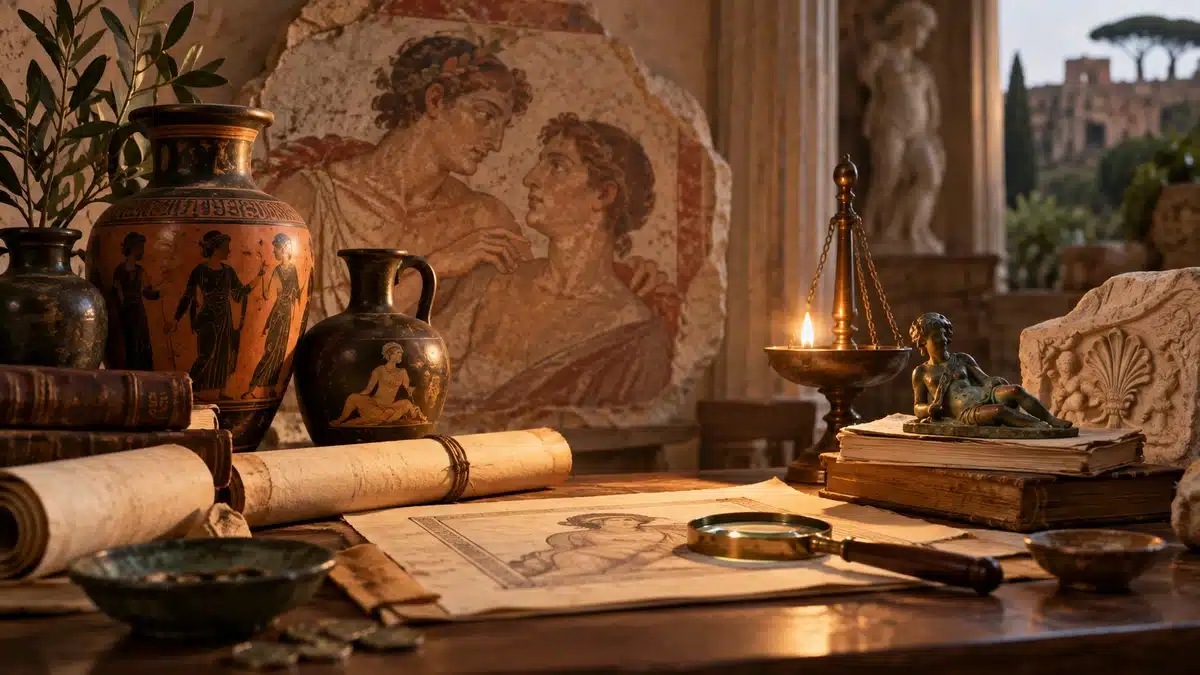
Ancient Sex: What History Really Tells Us About Sexuality

In this article

Reviewed September 2026
Quick answer

Ancient people had diverse sexual lives, but modern labels and assumptions do not map neatly onto ancient societies. Evidence from art, literature, inscriptions, law and sites such as Pompeii shows that sexuality was closely tied to class, gender, status, religion and power. Many sensational stories about “ancient sex tricks” are much less certain than popular articles imply.

Why ancient sexuality is easy to misunderstand

Popular articles often present the ancient world as either sexually liberated or shockingly depraved. Both pictures are too simple.

Ancient societies had their own ideas about status, gender, family, marriage, slavery, religion and acceptable sexual behavior. Modern categories such as heterosexual, homosexual or bisexual did not always organize identity in the same way.

What evidence do historians actually use?

Knowledge about ancient sexuality comes from several types of evidence:

  • Wall paintings and sculpture.
  • Household objects and decorative art.
  • Poetry, letters and satire.
  • Legal texts.
  • Graffiti and inscriptions.
  • Archaeological remains from homes, baths and brothels.

Each source has limitations. Satire can exaggerate, elite literature does not represent every social class, and erotic art does not tell us exactly what ordinary people did in private.

Pompeii gives an unusually intimate view

Pompeii and Herculaneum preserved homes, businesses, wall paintings, graffiti and everyday objects under volcanic ash. The British Museum has described these sites as providing an unusually detailed view of daily Roman life, including intimate domestic spaces.

Erotic imagery found there is important evidence, but it should not be interpreted as proof that every Roman household lived according to one sexual norm.

Roman sexuality was strongly shaped by status

Roman sexual expectations were deeply connected with social hierarchy. The status of a citizen, spouse, enslaved person, sex worker or freeborn youth could change how a sexual relationship was viewed.

That makes modern descriptions such as “the Romans were sexually free” misleading. Some behavior tolerated for powerful men existed inside highly unequal social structures.

Historical caution: consent and personal autonomy were not protected or understood in the same way across ancient societies. Describing an ancient practice does not mean endorsing it by modern standards.

Did ancient Romans distinguish gay and straight?

Not in the modern identity-based sense. Historical scholarship often emphasizes that Roman norms focused heavily on status, gender expectations and the social role a person occupied within sexual activity.

That does not mean same-sex desire did not exist. It means the social categories used to interpret it were different.

What about sex work?

Sex work existed throughout the ancient Mediterranean. Historical sources also show that many sex workers were enslaved or formerly enslaved, which is essential context when discussing ancient brothels or erotic commerce.

Modern retellings sometimes strip away that power imbalance and present ancient prostitution as uncomplicated sexual freedom.

Were ancient people using sex toys?

Objects interpreted as phallic or erotic survive from several ancient cultures, but archaeologists must be cautious about assigning one fixed sexual use to every phallic artifact.

Phallic imagery could also relate to fertility, protection, humor, religion or status.

Did people write about desire?

Yes. Ancient poetry and literature preserve love, jealousy, longing, infidelity and erotic attraction. Roman writers such as Catullus are famous for emotionally intense love poetry.

Again, literary voices mostly come from educated social groups and cannot represent every ancient person.

What about same-sex relationships?

Art and literature provide clear evidence of same-sex erotic relationships in the ancient Mediterranean. One well-known example is the Roman Warren Cup, which depicts male same-sex scenes.

Modern LGBTQ+ identities should not simply be projected backward, but the evidence also should not be erased.

Why the old “19 wild ancient sex facts” format needed changing

The original Winixu article leaned heavily into sensational claims. That kind of list can attract attention, but it often mixes evidence, interpretation and myth without showing readers which is which.

A stronger historical article explains what we know, how we know it and where uncertainty remains.

When reading claims about ancient sexuality, ask:

  • Is the claim based on archaeology, literature or modern speculation?
  • Was the source satirical or intended as factual description?
  • Does the evidence come from elites or ordinary people?
  • Are modern identity labels being projected onto another culture?
  • Does the story ignore slavery, status or lack of consent?
Bottom line: ancient sexuality was diverse and often surprising, but good history is more interesting than a list of exaggerated “weird sex facts.”

Frequently asked questions

What do we know about sex in ancient Rome?

Evidence comes from art, literature, law, inscriptions, graffiti and archaeology. Roman sexual norms were strongly shaped by gender, citizenship, class and social status.

Was ancient Rome sexually liberated?

That description is too simple. Some behaviors were openly represented or tolerated, but Roman society also had strict hierarchies, gender rules and unequal power relationships.

Did ancient Romans have same-sex relationships?

Yes. Art and literature provide clear evidence of same-sex desire and sexual relationships, although Romans did not organize identity using modern gay/straight categories in the same way.

Why is Pompeii important for the history of sexuality?

Its preservation provides unusually rich evidence from homes, businesses, wall paintings, graffiti and everyday objects from Roman life.

Are all ancient phallic objects sex toys?

No. Phallic imagery could have sexual, protective, religious, humorous or fertility-related meanings, so archaeological interpretation requires context.


Sources and further reading

About Winixu.net: Educational and informational guides about sexuality, relationships, intimacy, kinks and adult lifestyle. Content is intended for adults.

Ancient Sex: What History Really Tells Us About Sexuality

Reviewed September 2026
Quick answer

Ancient people had diverse sexual lives, but modern labels and assumptions do not map neatly onto ancient societies. Evidence from art, literature, inscriptions, law and sites such as Pompeii shows that sexuality was closely tied to class, gender, status, religion and power. Many sensational stories about “ancient sex tricks” are much less certain than popular articles imply.

Why ancient sexuality is easy to misunderstand

Popular articles often present the ancient world as either sexually liberated or shockingly depraved. Both pictures are too simple.

Ancient societies had their own ideas about status, gender, family, marriage, slavery, religion and acceptable sexual behavior. Modern categories such as heterosexual, homosexual or bisexual did not always organize identity in the same way.

What evidence do historians actually use?

Knowledge about ancient sexuality comes from several types of evidence:

  • Wall paintings and sculpture.
  • Household objects and decorative art.
  • Poetry, letters and satire.
  • Legal texts.
  • Graffiti and inscriptions.
  • Archaeological remains from homes, baths and brothels.

Each source has limitations. Satire can exaggerate, elite literature does not represent every social class, and erotic art does not tell us exactly what ordinary people did in private.

Pompeii gives an unusually intimate view

Pompeii and Herculaneum preserved homes, businesses, wall paintings, graffiti and everyday objects under volcanic ash. The British Museum has described these sites as providing an unusually detailed view of daily Roman life, including intimate domestic spaces.

Erotic imagery found there is important evidence, but it should not be interpreted as proof that every Roman household lived according to one sexual norm.

Roman sexuality was strongly shaped by status

Roman sexual expectations were deeply connected with social hierarchy. The status of a citizen, spouse, enslaved person, sex worker or freeborn youth could change how a sexual relationship was viewed.

That makes modern descriptions such as “the Romans were sexually free” misleading. Some behavior tolerated for powerful men existed inside highly unequal social structures.

Historical caution: consent and personal autonomy were not protected or understood in the same way across ancient societies. Describing an ancient practice does not mean endorsing it by modern standards.

Did ancient Romans distinguish gay and straight?

Not in the modern identity-based sense. Historical scholarship often emphasizes that Roman norms focused heavily on status, gender expectations and the social role a person occupied within sexual activity.

That does not mean same-sex desire did not exist. It means the social categories used to interpret it were different.

What about sex work?

Sex work existed throughout the ancient Mediterranean. Historical sources also show that many sex workers were enslaved or formerly enslaved, which is essential context when discussing ancient brothels or erotic commerce.

Modern retellings sometimes strip away that power imbalance and present ancient prostitution as uncomplicated sexual freedom.

Were ancient people using sex toys?

Objects interpreted as phallic or erotic survive from several ancient cultures, but archaeologists must be cautious about assigning one fixed sexual use to every phallic artifact.

Phallic imagery could also relate to fertility, protection, humor, religion or status.

Did people write about desire?

Yes. Ancient poetry and literature preserve love, jealousy, longing, infidelity and erotic attraction. Roman writers such as Catullus are famous for emotionally intense love poetry.

Again, literary voices mostly come from educated social groups and cannot represent every ancient person.

What about same-sex relationships?

Art and literature provide clear evidence of same-sex erotic relationships in the ancient Mediterranean. One well-known example is the Roman Warren Cup, which depicts male same-sex scenes.

Modern LGBTQ+ identities should not simply be projected backward, but the evidence also should not be erased.

Why the old “19 wild ancient sex facts” format needed changing

The original Winixu article leaned heavily into sensational claims. That kind of list can attract attention, but it often mixes evidence, interpretation and myth without showing readers which is which.

A stronger historical article explains what we know, how we know it and where uncertainty remains.

When reading claims about ancient sexuality, ask:

  • Is the claim based on archaeology, literature or modern speculation?
  • Was the source satirical or intended as factual description?
  • Does the evidence come from elites or ordinary people?
  • Are modern identity labels being projected onto another culture?
  • Does the story ignore slavery, status or lack of consent?
Bottom line: ancient sexuality was diverse and often surprising, but good history is more interesting than a list of exaggerated “weird sex facts.”

Frequently asked questions

What do we know about sex in ancient Rome?

Evidence comes from art, literature, law, inscriptions, graffiti and archaeology. Roman sexual norms were strongly shaped by gender, citizenship, class and social status.

Was ancient Rome sexually liberated?

That description is too simple. Some behaviors were openly represented or tolerated, but Roman society also had strict hierarchies, gender rules and unequal power relationships.

Did ancient Romans have same-sex relationships?

Yes. Art and literature provide clear evidence of same-sex desire and sexual relationships, although Romans did not organize identity using modern gay/straight categories in the same way.

Why is Pompeii important for the history of sexuality?

Its preservation provides unusually rich evidence from homes, businesses, wall paintings, graffiti and everyday objects from Roman life.

Are all ancient phallic objects sex toys?

No. Phallic imagery could have sexual, protective, religious, humorous or fertility-related meanings, so archaeological interpretation requires context.

Sources and further reading

Leave a Comment