
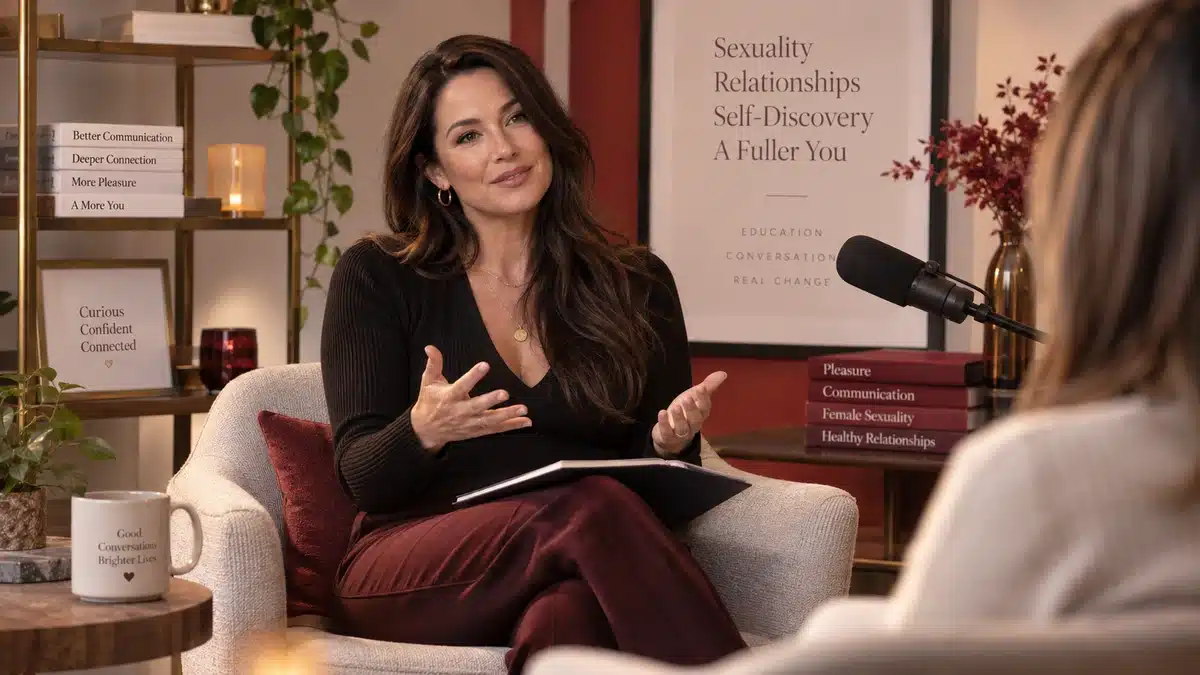
Caitlin V Neal is a sex and relationship coach and sexual-health educator with a Master of Public Health. Winixu’s existing feature focuses on themes she is known for discussing publicly, including sexual confidence, communication, pleasure, female ejaculation and reducing shame around sex.
Who is Caitlin V?
Caitlin V Neal is a U.S.-based sex and relationship coach and sexual-health educator. Her current professional materials describe more than a decade of work helping individuals and couples with sexual confidence, intimacy, mismatched desire, performance concerns and communication.
She holds a Master of Public Health and has built a large public-facing education platform around practical sex coaching.
What themes stand out in Caitlin V’s work?
Sexual confidence without performance pressure
A recurring theme in Caitlin’s public work is that better sex is not simply about mastering a technique. Confidence, realistic expectations and the ability to talk about what is happening can matter just as much as physical skill.
That approach is useful because people often turn ordinary sexual variation into a performance test: whether they orgasm quickly enough, ejaculate, maintain arousal perfectly or respond in the “right” way.
Communication as a sexual skill
Good sexual communication is not limited to asking for consent once. It includes discussing preferences, changing course when something stops feeling good, asking for more or less stimulation and being able to talk afterward without shame.
Our guide to foreplay and communication explores the same principle: useful technique starts with paying attention to the person in front of you.
Female ejaculation: what should readers know?
Female ejaculation and squirting are frequently blended together in popular sex education, but research increasingly treats them as related yet distinct phenomena.
Scientific reviews describe female ejaculation as the release of a smaller amount of fluid associated with the paraurethral or Skene’s glands, while squirting generally refers to a larger-volume urethral fluid that contains a substantial urinary component.
Neither response is required for orgasm, and neither should be treated as evidence that one person’s sexual response is “better” than another’s.
What about the G-spot?
The idea of a single, clearly defined anatomical “G-spot” remains controversial. More recent sexual-anatomy research increasingly describes pleasure from the front vaginal wall in terms of the broader clitoral, urethral and vaginal structures interacting together rather than one isolated button.
That means people can absolutely experience strong pleasure from anterior vaginal stimulation without needing to “find” one exact anatomical point.
If you are exploring dual stimulation, see our guide to blended orgasms.
Why reducing pressure matters
One of the most useful lessons in modern sex education is that sexual response varies. Some people orgasm from one kind of touch, others need several forms of stimulation, and some do not orgasm every time.
Turning ejaculation, orgasm or a specific technique into a goal can make people monitor themselves rather than remain engaged with sensation.
Practical takeaways:
- Ask what feels good instead of assuming.
- Do not treat ejaculation or orgasm as a performance requirement.
- Use anatomy as a guide, not a rigid map.
- Let feedback change what you are doing in real time.
- Separate sexual confidence from “perfect” sexual response.
Is Caitlin V a therapist?
Caitlin’s current professional materials describe her as a sex and relationship coach and sexual-health educator. Coaching, education and licensed psychotherapy are different services, so readers looking for treatment of a mental-health condition should choose an appropriately licensed clinician.
Frequently asked questions
Who is Caitlin V Neal?
Caitlin V Neal is a sex and relationship coach and sexual-health educator with a Master of Public Health who creates educational content about intimacy, confidence and sexual wellbeing.
Is Caitlin V a sex therapist?
Her current professional materials describe her as a sex and relationship coach and educator rather than a licensed therapist providing psychotherapy.
Is female ejaculation the same as squirting?
Research increasingly distinguishes them. Female ejaculation is usually described as a smaller-volume secretion associated with paraurethral glands, while squirting generally involves a larger volume of urethral fluid with a substantial urinary component.
Does everyone with a vagina have a G-spot?
There is no strong evidence for one universally distinct G-spot structure. Some people experience strong pleasure from the anterior vaginal wall, while others do not.
Is ejaculation necessary for a satisfying orgasm?
No. Ejaculation is not required for orgasm or sexual satisfaction, and sexual response varies widely from person to person.